Thursday, June 4, 2009

Charles Bock - Beautiful Children


Watching this documentary on 20th Century American literature, the narrators likened the introduction of the papaerback novel to today's ipod fascination. The new publishing format allowed folks (teens mostly) to pass off and trade new ideas, highlighted and dogeared with attractive covers, and gave the beat writers of the era a new vehicle for success. Kerouac and Burroughs novels were locker transients and the written word as they crafted it sculpted an entirely new cultural perspective.
I've got some of those old survivors of the paperback era. They're in pretty sad shape after half a century of readings, but one thing that still impresses is the cover price, usually a meager .95. New paperbacks today run upwards of $20, a further indication of literary elitism. Sure, there's always the library but what loser wants to be seen there?
Too bad really, because there are some contemporary writers who truly do have their finger on the current cultural pulse. Writers whose product is edgy, critical, and deeply observant. Writers who take the familiar language and twist it around their fingers, tie it in knots like a shoelace and hook you like a finely played guitar melody. Chuck Palahniuk leads the pack as far as name recognition goes and his style has inspired a host of new voices. Unfortunately, he has also inspired a host of immitators and Beautiful Children seems as much.
Charles Bock's debut novel Beautiful Children is, at its core, a novel about teenage runaways. Problem being, it winds slow, undulating circuits around the core without ever actually getting there. His characters are meticulously constructed, so much so that they overshadow the plot, slowing the story's pace to a frustrating crawl far too often.
Bock's novel is set in Las Vegas and I first heard of him listening to an NPR interview while driving back from there. Gotta say, having an actual impression of the setting he paints made the reading a lot easier to digest. He paints the town as a character unto itself, which is appropriate. Newell, the missing kid in question only actually goes missing within the last ten pages as the novel is frustratingly out of chronological order. Story threads interweave in uncontrolled, chaotic patterns and Bock's attempts at linear ideas get tangled up in the mess of progression.
Too often Bock relies on pornographic level shock-tactics to entertain his reader instead of solid storytelling. While he can twist a phrase and provide just the right level of controlled imagery for the reader to clutch a scene, it rarely develops into a satisfactory one and that is essentially the problem that hobbles the entire novel.
At one point toward what passes for a climax in the story, a group of kids find themselves at a party in the desert. A band called Not To Be Fucked With plays badly rendered punk rock and the narrating character notes how it's all style before content, the rhythm never in sync with the melodies. In itself, this is a fair summation of the novel. It is dirty, but not in an enjoyably naughty way, just in a gritty, unpleasant way. Ideas remain undeveloped, threads hang loose, and anticipated resolution disolves like whatever Bock has been smoking.
Bock shows promise in his confident manipulation of the language and his characters which ooze verisimilitude, but his style and attitude need maturation that his later works will hopefully develop.
Good thing this one came courtesy of the local library...

Tuesday, May 12, 2009

All Things Superdrag

So I'm 13 years old, in the miserable pinacle of my awkward phase. I come home from another shitty day at school with a bag full of homework that I'll ignore in favor of rereading comic books. I grab a handfull of Oreos and plop my lazy ass in front of the TV, where I can spend the hour before my mom get home in its warm, mind-numbing glow. And then this comes on...


Holy hell! This video still timewarps me. The escapism that it demonstrates is something that I yearned to achieve day in and day out and I could live vicariously thru John Davis' gusto and attitude that he strutted in the captivating video. It's lost none of its affect. My enthusiasm for grunge was pretty much feigned. It's muddy guitar work and meaningless apathy devalued the music, I felt. Superdrag showed me power-pop with bite. Unlike Weezer, who wore their melodic sensibilities like a pair of horn-rimmed glasses, Superdrag spit it like fire. I have bought Regretfully Yours, the album that features 'Sucked Out' three times, I listen to it so much. When people gush about how much Nevermind blew their pubescent mind, this album is how I relate.

The sweet hooks and sugary choruses are ones that I would later find in the catalogues of The Kinks and, especially, The Zombies. Besides the straight out rockers like 'Sucked Out' and 'Destination Ursa Mojor,' 'Nothing Good is Real' is a hidden gem of a ballad that bowled me over with its massive crescendo and glorious guitar crests. Check it out on the left.
Did I mention I was in my awkward phase? Well, I wrote a typical fan letter to the contact address in the CD booklet and, lo and behold, a few weeks later, in the mail comes a hand written letter from Don Coffey, the band's drummer. To a nerdy teenager in rural Pennsylvania, this is like a visitation from the angel Gabriel. It showed me a whole new type of band that could actually be bothered to let their fans know that they were appreciated.
I got Head Trip in Every Key, the band's sophomore album, the day before it came out at one of the local record shops that would inevitalby be gone soon and that made me feel special. I listened to it on my discman at school during rehearsal for the spring musical and imagined myself as one of the first people listening to the new songs and fell in love with the music and the pretty girl between the headphones on the cover.
The opening track, 'I'm Expanding My Mind,' a breezy and uplifting tune, did what it promised. The glory that is 'Pine Away' made me light-headed, and the epic scale of the finale, 'The Art of Dying' pierced me thru.
After being exposed to so much music, it's rare that things move me like they did in these days of discovery, but 'The Art of Dying,' with its expertly inserted sitar, remains an earth-shaking.
In the Valley of Dying Stars, finds the original band disintegrating, with singer/songwriter John Davis using the album as a means of coping with the loss of his father. The results are mostly dark and brooding as on 'The Warmth of a Tomb,' and 'Unprepared.' A couple of major-chord driven tracks like 'Lighting the Way,' revive some of the more meldoic memories of the band's first two albums. 2003's Last Call for Vitriol, is not a pretty affair. Check out the saving grace number of The Staggering Genius at left as one of the few bright spots on a fractured, meandering collection of songs.
Then, the hiatus and John Davis' born again Christianity. The man who menacingly eyeballed the camera while lighting a cigarette from George Washington's burning face turned to Jesus Christ for help with his solo work. I was not aware that Jesus knew how to play any insturments, but Davis manages to work his presence in pretty smoothly on his two solo works, a self-titled debut and Arrigato, which employ Brian Wilson sized melodies to make the songs so damn enjoyable that you don't even care what the lyrics are preaching. The stregnth of Davis' faith is admirable thru these records and the stregnth of his songs make them more than simply interesting curios for the Superdrag superfan.
And now for the triumphant reutrn:

The thing is, I'm happy to say, I'm not being sarcastic. 'Industry Giants,' takes a couple spins to make it's mark but strightaway with 'Slow to Anger,' Superdrag show they've still got pleanty left in the tank. In a era where many of my teenage favorites are planning their reunions and falling flat on their face (see that old Verve review, and to Spacehog: don't f*ck it up), Superdrag pull it off. 'Industry Giants,' lacks the ultimate cohesion that makes Regretfully Yours the alt-rock juggernaut, but its urgency and energy make it authentic. The single, 'Everything'll Be Made Right,' sounds vintage and thunder-laden. The guitars are as cascading as ever and, with the original lineup back in place, the chemistry comes across in every song.
It's nice to have at least one thing from that awkward period that you can hold onto with pride.

PS - Hooray for the learning curve! I'll try to hook up tracks to all of the music I ramble about from here in.

Saturday, May 9, 2009

N*E*R*D - Seeing Sounds


Guilty pleasures. They are things that approach respectability but fall just short. Their failure is made even more evident by seeing the potential for true greatness right behind the veneer of ambivilance, incinsistency, or silliness. There HAS to be something that is REALLY good in order to make the pleasure large enough to overshadow the guilt or embarassment that comes with it. It's got to be so completely over the top that it overwhelms your better judgement.
Musically, my top three guilty pleasures are (in order): Berlin, Rammstein, and N*E*R*D. There's something, even if it's just one thing, awesome about each of these. Berlin's 'Take my Breath Away' does just that every time I hear it. It's so brilliantly grandiose with its synthesized tubular bells that it doesn't matter how ridiculously sappy it is, it puts on such a convincing facade of true emotion that I will defend it like a knight does a princess. Rammstein's visceral intensity makes me faster when I go running.
N*E*R*D's music worms into you. Pharrell Williams crafts beats and loops in such a way that you truly believe that he does see sounds, as the newest album's title suggests. The sweetness of the beats makes the album go down easily, but the sheer dumbness of some of the tracks still comes thru with bitter obviousness from time to time. When the songs themselves are good, N*E*R*D's tunes rock with the best, but their duds are epic and give their albums a sabatoging inconsistency.
In an era where false artists craft albums full of filler to support an album relying on one or two standout tracks, I wouldn't accuse N*E*R*D of this as it's the same problem that has weighted down each of their albums back to 2003's In Search of... Also, each of the tracks, no matter how bad, feels like it has been slaved over.
Seeing Sounds is half great. Of it's twelve tracks, six of them are so listenable and unique, they invade your mind and take over. Lyrically, N*E*R*D again demonstrates their extreme inconsistency. Pharrell segues between rapping and singing easily, and does both well. While pigeon-holed as rap, N*E*R*D's musical taxedermy defies easy categorization. 'Windows,' for example is sraight away the finest rock song N*E*R*D has recorded. With a Kinks-style guitar hook, and lyrics detailing the character's vouyeristic tendencies, the song feels like the British Invasion revisited by urban America.
'Everyone Nose (All the Girls Standing in the Line for the Bathroom),' is production perfection and conceals its barbs against the chic idiocy of cocaine nightlife well enough to get airplay.
The middle of the album shows N*E*R*D at their peak. Their album art, depicting the members floating thru space, exploring new territory is suddenly fitting. It culminates with 'Happy,' a euphoric number that employs guitar wahs and an infectious beat to overcome any listener hesitancy.
'Happy' is such a standout that it makes the following faltering all the more evident. 'Kill Joy' shows what happens when the production goes haywire and 'Love Bomb' shows that Pharrell would do well to get a second opinion of his lyrics from time to time.
Thru the highs and the lows, N*E*R*D is, at least, authentic. They don't compromise their sound and seemingly pursue their vision to the best of their ability. When the results are good, they can be good enough to make you forget about the clunkers and make you keep hoping for that thoroughly solid album that they keep trying to make.

Tuesday, April 21, 2009

Bat for Lashes - Two Suns & Fever Ray

Looking through the compilation section at the record store the other day, I was struck by a realization and a memory simultaneously. The memory came first: I was in ninth grade, riding the band bus to a parade. The era of the ipod and segregated listening had not yet dawned and so the upper classmen brought a boombox, sat in the back and filled the bus with a dictatorship of sound. This time, it was Rage Against the Machine. While I appreciate the band and their content, they've always been a bit too repetitive for my taste. My friend sitting next to me was a fan of Billy Joel and jazz played on trumpet. He turned and said, "You know, when we get old, classic rock radio is going to really suck."
As I picked up decade-spanning compilations, it was easy to see how we've defined our past half century through its popular music. You will likely never see a '70's compilation without Carole King on it. You will never see an '80's compilation without Duran Duran on it. While Rage Against the Machine won't make it onto too many '90's comps, it'd be better for most of them if they had. While Rage may be too hard for some listeners to deal with, the validity of their music eclipses the buzzbin output of most of their well-remembered contemporaries.
Even if the CD industry weren't bleeding to death, it's hard to imagine a '00's compilation. It's a frightening prospect to consider what passed for popular music over the past decade, and unlike the past few decades, that strong connection between society and its literal rhythm is weak, if not broken. Whereas Peter Gabriel, Tears for Fears, and others were what the 1980's sounded like, what does it sound like today?

These two albums ARE the contemporary sound. They are both dark but tender, cold but welcoming, progressive yet comfortable. They take familiar elements and build on them, creating vast, moody soundscapes that warp their imagery and structure something completely alternatative. Postemodernism is a gooey term that I don't use often, but it applies to these two works.
Two Suns is Bat for Lashes' second album. On her previous work, Natasha Khan's project sounded like an adapted Black Box Recorder; now her vocals have matured to a transendency exhibited by Kate Bush in her best days. The album opens with some absorbing numbers. 'Glass,' and 'Sleep Alone' are a great one-two opener; deep, dark, and shimmering. The synthesized sounds that create the glittery dance of the music provide the aura that Two Suns is dependent on. After the pop-bliss of 'Daniel,' the album slows down into a series of misty numbers that suggest smoke and mirrors. By this point though, the album has suspended your disbelief and the listening experience is pure magic.

The aesthetic experience of the album is mirrored in, what strikes me as a related work, Fever Ray. Check out the cover art and you'll see the similarities begin immediately with the lone figures acheiving a sort of tactile balance. This is the first album under the name, but Karin Dreijer Andersson, honed her music talents on 2006's exquitise album Silent Shout, by The Knife. The synths here delve deeper and explore darker, more subconscious territory than Bat For Lashes. In a way, Two Suns is a listening exercise for Fever Ray. The synth-drenched soundscapes supplement to form a unique cinematic environment. 'If I Had a Heart' plays like a march for Yeats' rough beast, and is about as radio-unfriendly a "single" as I've ever heard. 'When I Grow Up,' is a wonder in contrast. The imagery is lush and verdant, while the sound is glossy and cascading, the effect reminiscent of Blonde Redhead's trembling, yet strong vocal delivery. 'Dry and Dusty' adds further mass to the album and makes it completely inescapable from there on in. Listening to it is like listening to the music from John Carpenter's '80's flicks with their pulsing, suspenseful sound that is weighted with sinister promises.
Fever Ray is unquestionably a lonely, introverted album. Yet while most artists find either weepy, mopey guitar tunes or angry, shouty guitar tunes the best way to express those feelings, Fever Ray do neither. They create their own lonely sound and it is stupefyingly beautiful. Its bold confrontation of inner feelings in crisis and at odds with one another may be the best audio representation of our current cultural climate I've heard since Neon Bible.
While it certainly would never have gotten played on the band bus' boombox, the best, most defining music NEVER did. As our culture encourages isolation and the boombox's massive speakers die off like dinosaurs to give way to the highly individualized earbuds, Bat for Lashes and Fever Ray prompt musical evolution with a nostalgic look over their shoulder. They pay homage to the sound that brought us here, provide impressions of where "here" is, and look ahead with dark determination.

Thursday, April 16, 2009

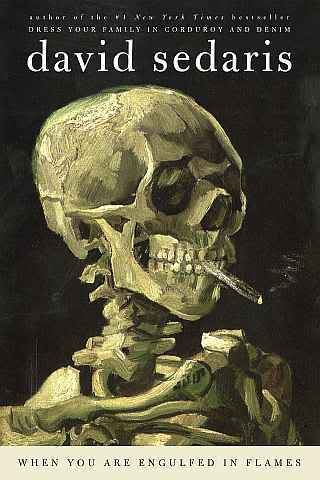
David Sedaris - When You Are Engulfed in Flames


In an era of visual media saturation, eliciting a laugh-out-loud response is becoming increasingly harder for the print medium. Humorists have to work twice as hard for diminishing results.
While I often find the actual authenticity of David Sedaris' memoir writings questionable, it doesn't particularly matter whether they are true or not because they COULD happen and that is enough. His pieces, while undoubtably exagerated accounts, provide effective, identifiable associations for the reader.
When You Are Engulfed in Flames shows Sedaris' sharpest, wittiest, and most focused writings to date. The book has a coherency which his earlier books lacked. While this is a collection, there is something about the sequencing of the pieces and the overall flow that ties it together remarkably well.
He hits on familiar areas throughout the book; his familiy, his partner Hugh, childhood memories, and smoking. The final chapter, a longer bit entitled 'The Smoking Section,' is his best writing to date. Laid out with dynamics that are little short of verbally symphonic, he chronicles his struggle to quit smoking, laying out the particular pleasures, the crutch of the patch, and the curious void of self-fulfillment felt afterwards. His fight against nicotine addiction is set against the backdrop of his living experiences in Japan. Overlaying the experiences uniquely connects both subjects and gives each of them greater resonance. As he moves through an alien environment, trying to learn the language well enough to tell the difference between bottles of shampoo and baby lotion, he feels alien to himself without a cigarette between his lips. With humorous and practical examples, he dredges the notions of suffering and the desire for familiarity as he purposefully denies vices disguised as comforts.
Rather than go straight for a laugh, Sedaris nimbly dances with his accounts, using referential humor and honest human connection to paint scenes that pan the entire emotional landscape, often within a single ten page poigniant story.
Bonus points for the predictably awesome Chip Kidd cover.

Saturday, April 11, 2009

The Soundtrack of Our Lives - Communion


What a pity no one believes that the power of a rock n roll record can change the world anymore. It wasn't too long ago that The Beatles, The Clash, hell, even Nirvana did more than impact the music scene, they broke the genre's self-created boundaries and became cultural mammoths showing what happens when the power of the music is unleashed.
That's not to say that The Soundtrack of our Lives' new album, Communion, is on the same level as London Calling. It is, however, a perfect example of how the new means of marketing and listening to music; digitally, on a track by track basis, rather than for the album's flow and overall message, will not allow an album created as a coherent whole to make such an impact.
Appropriately, this is the sort of ideology that TSOOL lambast against in Communion. Whereas one of the things that bugs me about that last Swedish rock export, Peter, Bjorn, and John, is that it seems almost purposefully in denial of contemporary reality, thumbing its nose at things that can't be laughed at anymore, TSOOL boldly take on these issues from Communion's start to its finish.
Oh, yeah and that end...well, give yourself some time. Communion is a double album that plays for over an hour and a half. Improbably though, there are no clunkers. Not every song reaches the anthemic heights of its brightest spots, but for as long as it is, it maintains its pace like a triumphal march.
Opening, Communion builds slowly up to the throbbing bassline of 'Babel On,' a track that acurately foreshadows the long journey ahead. The pun is apparent if you know the Biblical story. Whereas communication differences may have allowed cultural diversity to thrive, the fact that an omniscient god would prevent a single global tongue is sadistic and purposefully antagonistic. In our shrinking world where communcation breakdowns lead to cultural ideological differences, which lead to more and more global conflicts, a united language would prove undoubtably beneficial. Addressing the issue, lead singer Ebbot Lundberg yawningly sings, "The language that we speak was spread out to complete and communicate as one so turn the towers of Babel on."
A bit more than halfway thru the first disc, the band throws a curveball with a cover of Nick Drake's Fly. While it may not seem a likely fit, TSOOL put a beat behind the weepy folk tune and bring it up to speed with the rest of the album. The song's melancholy is preserved, but only for those listeners who know to look for it as it is covered with cheerful twelve-string guitar and tom tom percussion. The result is a cover that does what its supposed to. It stays respectful to the original but provides a new perspective and toys with fresh insturmentation.
While the first half of Communion keeps its focus on upbeat British invasion style rockers, the second half waxes more acoustic. Focused and precise, the second half showcases some truly beautiful numbers. The last two tracks, Lifeline and The Passover provide a solid capstone, leaving the listener humbled and hopeful. Lifeline is an introspective track that attempts to help the listener locate and establish whatever connection they can in our society of alienation. The Passover is the sound of gray clouds parting to let in golden light.
TSOOL have always been about big sounds, sounds that have always seemed a little derivitive of their British peers. With Communion, their ambition elevates them over all the bands they draw comparisons to; its a career album that shows a band meeting and exceeding their potential.
Communion is an album out of time. The degree of concentrated listening necessary to appreciate its complexity is one that few will ever get. Sad, because TSOOL's substantial messages are sugar coated with some very sweet tunes. Released forty years ago, this album goes side by side with Physical Graffiti, but today will garner a cult following who find themselves personally reflected in its songs. Maybe its better this way.

Wednesday, April 1, 2009

Peter Bjorn & John - Living Thing


Every artist inevitably lives in the shadows of their former work. It would be nice to think of every artist making a steady evolution; getting better, more complex, and skilled with each new piece of work, but this so rarely happens. That's why we have the phrase "sophomore slump" and that's what Living Thing exemplifies.
Peter Bjorn & John's first album is full of so many majestic high points that it seemed improbable that they'd be able to repeat its brilliance. However, Living Thing's highest points barely approach the lows of Writer's Block.
The ubiquitous whistle that burned itself into the public consciousness from 'Young Folks' is the rare piece of music that makes you feel as though you've heard it before the first time it seeps into your ears. It is the rare track that feels both familiar and new. Even after hearing it at the grocery store, while pumping gas, and backing up network television shows, it is a song that brings undimished pleasure with every spin.
To expect another 'Young Folks' would be foolish, but this...
Comparing the albums, it is easy to see that Writer's Block is the true living thing, while the new LP better suits its predecessor's title.
No one else seems to have noticed that the hook from the first single, 'Nothing to Worry About,' is a repetition of 'Amsterdam' from the last album. It sounded better the first time around and the kids' chorus that 'Nothing...' relies on for its drive is ineffective and confounding. After a disapointing first half, the listener hopes for a pickup, instead we get 'Lay it Down,' an uncharacteristically abrasive track that completely disagrees with the album's flow and rudely halts any forward momentum.
Credit the Swedish trio with at least making an effort to vary their sound. They back off from the sharply honed pop edges that carried Writer's Block and attempt some darker, more syrupy textures. Songs like 'The Feeling' approach breakout moments numerous time but are never allowed the space to grow, which ultimately proves to be the case for the entire album. By the end of Living Thing, it has faded into background noise and that is not what PB&J are about.